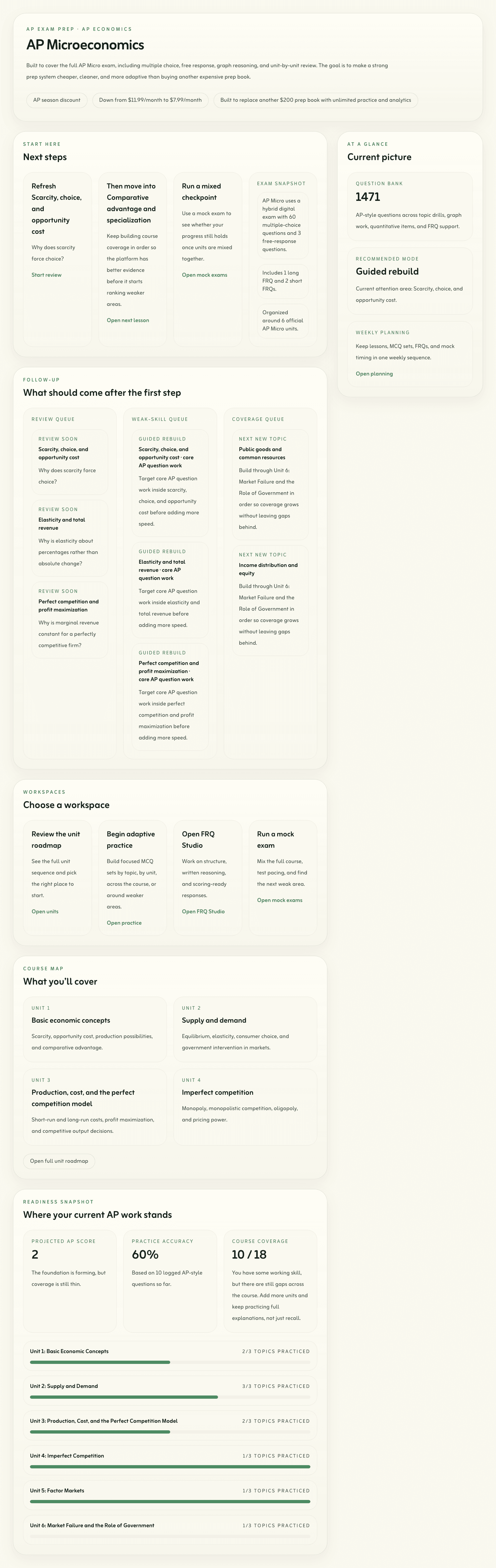
Course overview
See the course structure, your current priorities, and the main study tools in one place.
AP exam prep
Study AP Calculus AB with guided units, unlimited practice, FRQ support, mock exams, analytics, and AI coaching in one place. The goal is to keep lessons, practice, written work, mock exams, and review moving inside one focused study rhythm instead of scattering them across disconnected resources.
See the course structure, your current priorities, and the main study tools in one place.
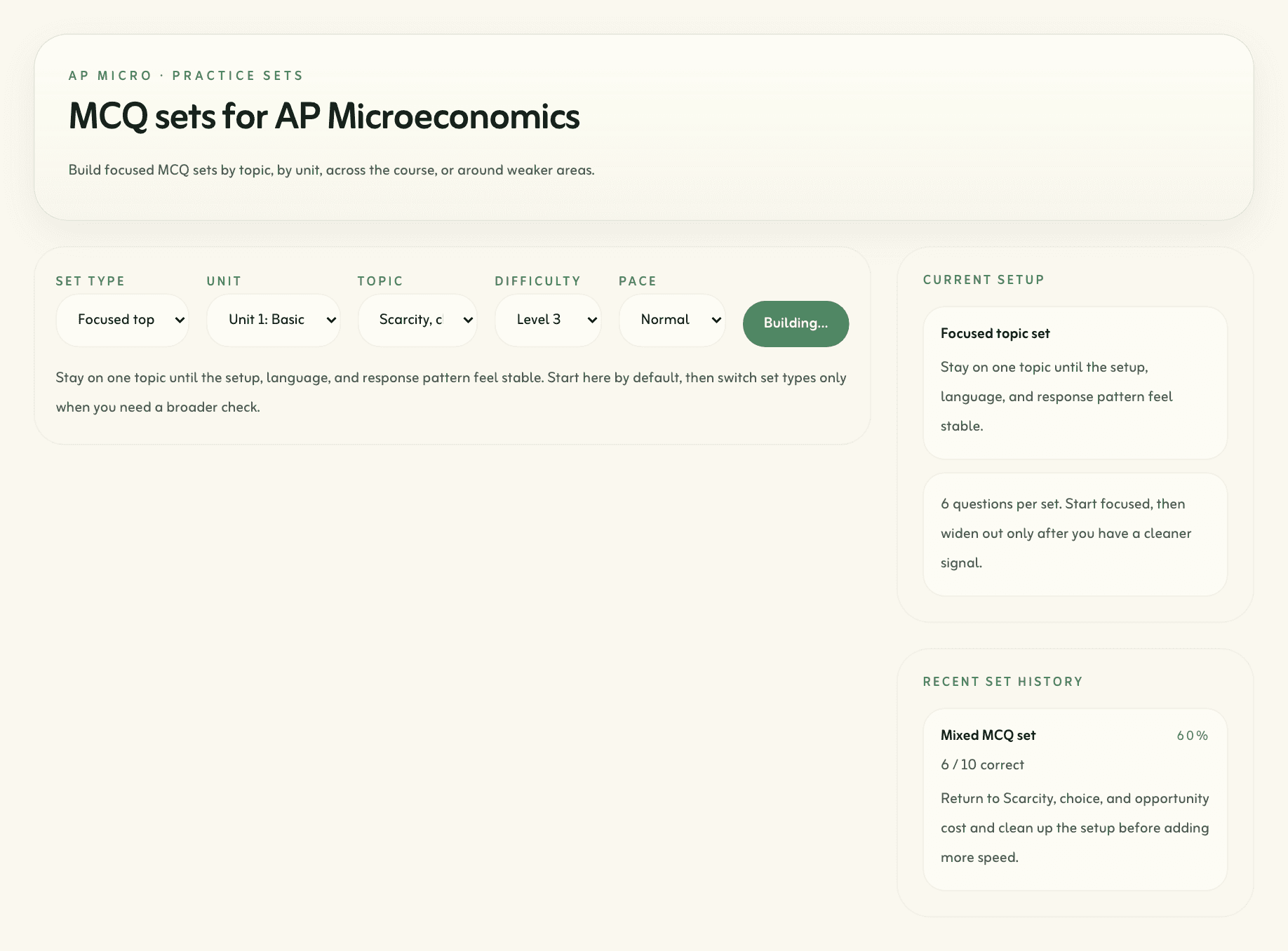
Keep question work focused around the exact topic, graph, quantitative setup, or explanation skill that still needs reinforcement.
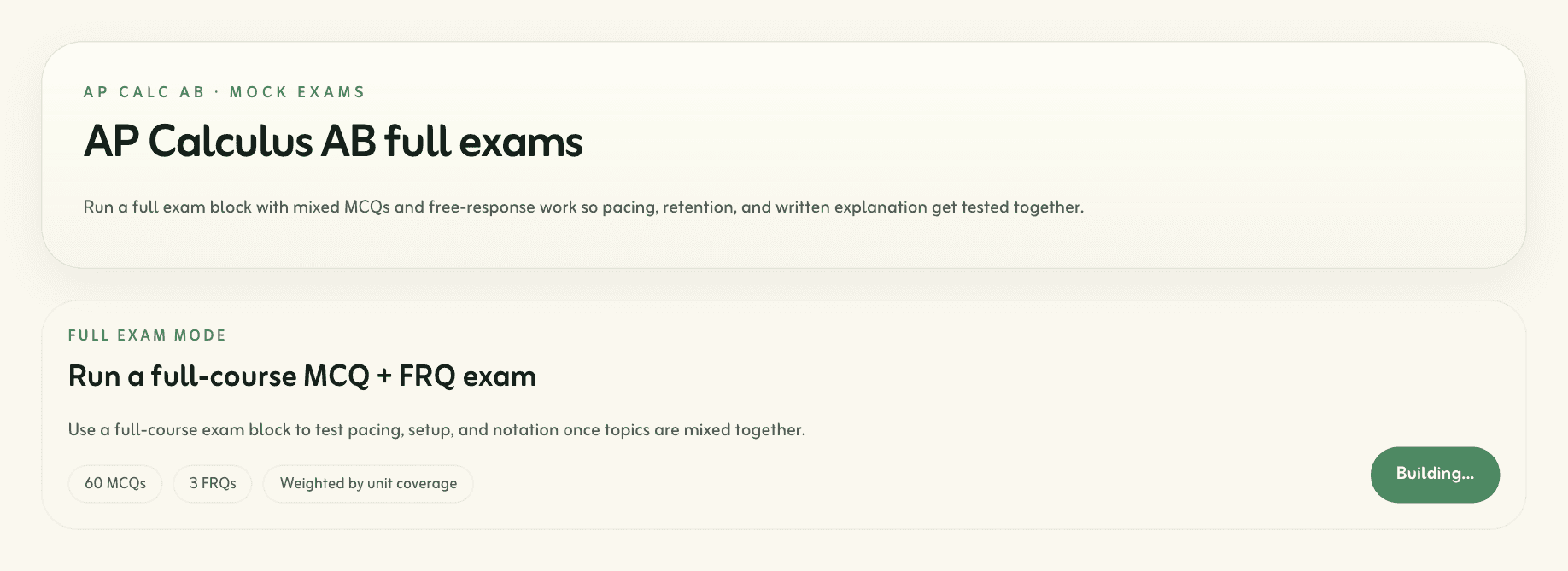
Bring the work back together through FRQs, mocks, or the broader course view so progress feels connected instead of scattered.
Why this path is worth the time
How the prep flow works
Course coverage
Built for AP Calculus AB students who want one focused study system for unit review, calculator and non-calculator work, free response practice, and clear analytics.
Foundations of limits, continuity, and behavior of functions.
Derivative meaning, estimation, and introductory interpretation.
Chain rule, implicit differentiation, and inverse relationships.
Rates of change and modeling from verbal, graphical, and tabular data.
Extrema, optimization, motion, and curve analysis.
Definite integrals, accumulation, and area interpretation.
Slope fields, Euler’s method, and separation of variables.
Average value, area between curves, and accumulation-based applications.
Fintellect AI
Create your account, or log in if you already have one.